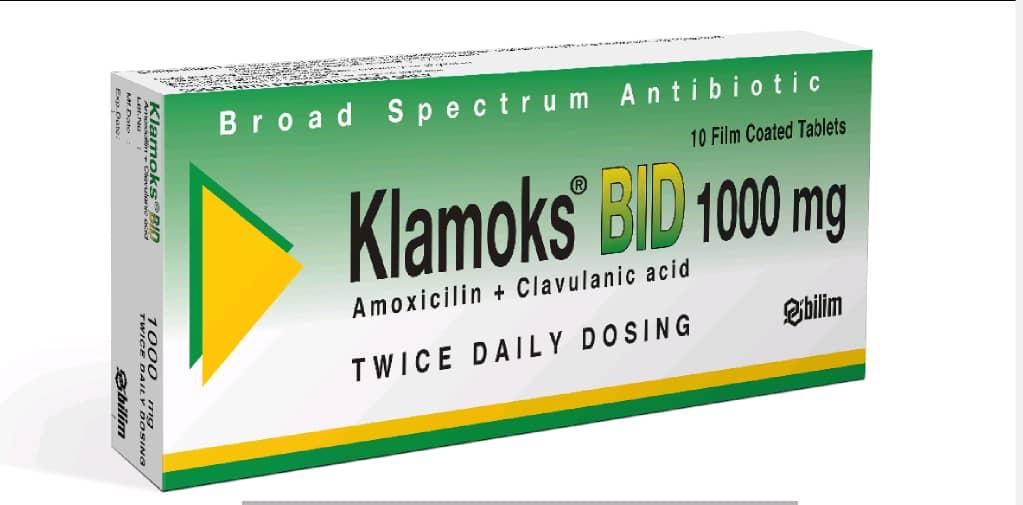
Comprehensive Clinical Monograph: Klamoks 1g (Amoxicillin / Clavulanic Acid)
1. Comprehensive Introduction & Overview
Klamoks 1g is a potent, broad-spectrum antibiotic combination medication belonging to the penicillin class of beta-lactam antibiotics. It is formulated as a fixed-dose combination of Amoxicillin trihydrate (875 mg) and Potassium Clavulanate (125 mg).
In the landscape of modern medicine, Klamoks 1g serves as a cornerstone therapy for managing moderate to severe bacterial infections that are suspected or proven to be resistant to standard penicillin monotherapy. The clinical significance of this combination lies in its ability to overcome bacterial resistance mechanisms—specifically, the production of beta-lactamase enzymes by pathogenic microorganisms.
As an orthopedic and clinical specialist, it is imperative to recognize that Klamoks is not a "first-line" drug for every infection; rather, it is a targeted therapeutic agent designed to preserve efficacy against organisms that have evolved to deactivate traditional antibiotics.
2. Deep-Dive: Mechanism of Action & Pharmacokinetics
Mechanism of Action
The synergy between Amoxicillin and Clavulanic Acid is the defining feature of Klamoks 1g.
- Amoxicillin: A semi-synthetic penicillin that acts by inhibiting the biosynthesis of bacterial cell wall peptidoglycans. It binds to penicillin-binding proteins (PBPs) inside the bacterial cell wall, preventing cross-linking of peptidoglycan chains, which leads to cell lysis and death.
- Clavulanic Acid: A structural analog of penicillin that possesses weak antibacterial activity on its own. However, it acts as a suicide inhibitor of beta-lactamase enzymes. By binding irreversibly to the active site of these enzymes, it "protects" the Amoxicillin molecule from degradation, effectively expanding its spectrum to include beta-lactamase-producing strains.
Pharmacokinetics
Understanding the absorption and distribution of Klamoks is essential for dosing optimization:
| Parameter | Amoxicillin | Clavulanic Acid |
|---|---|---|
| Absorption | Well-absorbed orally | Well-absorbed orally |
| Protein Binding | ~17-20% | ~22-30% |
| Half-life | ~1 to 1.5 hours | ~1 hour |
| Metabolism | Minimal hepatic | Significant hepatic |
| Excretion | Primarily Renal | Primarily Renal |
3. Extensive Clinical Indications & Usage
Klamoks 1g is indicated for the treatment of specific infections caused by susceptible organisms. In clinical practice, its use is generally reserved for:
Respiratory Tract Infections
- Community-Acquired Pneumonia: Effective against Streptococcus pneumoniae and Haemophilus influenzae.
- Acute Bacterial Sinusitis: Often utilized when initial therapy fails.
- Acute Exacerbations of Chronic Bronchitis.
Skin and Soft Tissue Infections
- Cellulitis: Particularly when caused by Staphylococcus aureus (MSSA).
- Animal/Human Bites: Prophylaxis and treatment for polymicrobial wound infections.
- Post-operative Wound Infections: Common in orthopedic surgery to prevent or treat deep tissue infections.
Genitourinary and Abdominal Infections
- Urinary Tract Infections (UTIs): Used for complicated cases or recurrent infections.
- Intra-abdominal Infections: Often used in combination with other agents (e.g., Metronidazole) for broad anaerobic coverage.
Orthopedic Considerations
In orthopedic practice, Klamoks 1g is frequently prescribed for:
* Prosthetic joint infection prophylaxis (in specific protocols).
* Osteomyelitis: As part of a multi-week regimen for susceptible bacteria.
* Open Fractures: Used as part of the initial antibiotic prophylaxis to cover skin flora and potential environmental contaminants.
4. Risks, Side Effects, and Contraindications
Contraindications
- Hypersensitivity: Absolute contraindication in patients with a history of severe allergic reactions (e.g., anaphylaxis, Stevens-Johnson syndrome) to any penicillin or cephalosporin.
- Cholestatic Jaundice: Patients with a history of hepatic dysfunction or jaundice associated with previous amoxicillin/clavulanate use.
- Severe Renal Impairment: Dosing must be adjusted or the drug avoided in patients with a creatinine clearance < 30 mL/min.
Common Side Effects
- Gastrointestinal Distress: Diarrhea (most common), nausea, and vomiting. These are often mitigated by taking the medication with a meal.
- Candidiasis: Overgrowth of Candida albicans (oral or vaginal thrush) due to the disruption of normal flora.
- Hepatotoxicity: Rare but serious, characterized by elevated transaminases.
Drug Interactions
- Probenecid: Decreases renal tubular secretion of Amoxicillin, leading to higher, potentially toxic serum levels.
- Oral Contraceptives: May decrease the efficacy of hormonal birth control; backup methods are recommended.
- Warfarin: May increase the anticoagulant effect (monitor INR).
- Methotrexate: Amoxicillin may reduce the clearance of methotrexate.
5. Pregnancy, Lactation, and Overdose
Pregnancy & Lactation
- Pregnancy (Category B): Generally considered safe during pregnancy. However, it should only be used if clearly indicated.
- Lactation: Both components are excreted in breast milk in small quantities. While generally considered compatible with breastfeeding, clinicians should monitor the infant for potential diarrhea or allergic sensitization.
Overdose Management
Overdose typically manifests as gastrointestinal symptoms (nausea, vomiting, abdominal pain) and electrolyte imbalances.
* Treatment: Discontinue medication, monitor renal function, and maintain fluid/electrolyte balance.
* Removal: Both Amoxicillin and Clavulanate can be removed from circulation via hemodialysis.
6. Massive FAQ Section: Clinical Queries
Q1: Can I take Klamoks 1g on an empty stomach?
While it can be taken on an empty stomach, taking it at the start of a meal is highly recommended to minimize gastrointestinal side effects and improve absorption.
Q2: What should I do if I miss a dose?
Take the missed dose as soon as you remember. However, if it is nearly time for your next dose, skip the missed dose entirely. Do not double the dose.
Q3: Why does my doctor prescribe it for a sinus infection if it’s "just a cold"?
Klamoks 1g is for bacterial infections. If your doctor prescribed it, they have determined that your symptoms—such as fever, purulent discharge, or prolonged duration—are consistent with a bacterial etiology, not a viral one.
Q4: Is it safe to drink alcohol while on Klamoks 1g?
While there is no direct pharmacological interaction between alcohol and Klamoks, alcohol can exacerbate dehydration and worsen gastrointestinal side effects, potentially delaying your recovery.
Q5: How long does it take to start working?
Most patients feel improvement within 48 to 72 hours. However, it is critical to finish the entire prescribed course, even if you feel better, to prevent the development of antibiotic resistance.
Q6: Can Klamoks 1g cause a rash?
Yes. A non-allergic maculopapular rash can occur, but you must distinguish this from a true allergic reaction (hives, difficulty breathing). Any rash should be reported to your physician immediately.
Q7: Why is it 1g? Is that a high dose?
The 1g refers to the total mass of the active components (875mg Amoxicillin + 125mg Clavulanate). It is considered a standard "high-strength" adult dose for moderate-to-severe infections.
Q8: Does this medication interact with other antibiotics?
Yes, it can interact with bacteriostatic antibiotics (like tetracyclines or macrolides). Always inform your doctor of all medications you are currently taking.
Q9: Should I take probiotics while on this medication?
Probiotics may help maintain gut flora and reduce the risk of antibiotic-associated diarrhea. It is best to space the probiotic out by at least 2 hours from the antibiotic dose.
Q10: What if I have a history of penicillin allergy?
If you have a documented history of IgE-mediated penicillin allergy (hives, anaphylaxis), you must inform your provider. Klamoks 1g is generally contraindicated, and an alternative antibiotic class (e.g., macrolides or clindamycin) will likely be chosen.
7. Clinical Summary for Healthcare Professionals
When prescribing Klamoks 1g, the clinician must always weigh the benefits against the risk of Clostridioides difficile-associated diarrhea (CDAD), which can occur with any broad-spectrum antibiotic. In orthopedic settings, ensure that the patient’s renal function is documented, as the 875/125 ratio is not suitable for patients with severe renal insufficiency without dose modification.
Disclaimer: This guide is intended for educational purposes for healthcare professionals and patients. It does not replace the professional judgment of a licensed physician. Always consult with your healthcare provider before starting or stopping any antibiotic therapy.
Document End - Prepared by Medical Editorial Board